
Highlight
AnewDesign connects generative design, structure-based evaluation, and experimental feedback in an agent-assisted workflow for antibody discovery. Building on our team's research in protein generation and binder design, it supports nanobody generation and iterative affinity optimization. In a proof-of-concept campaign against an internal protein target, 16 of 150 tested clones achieved single-digit nanomolar binding affinities measured by surface plasmon resonance (SPR), corresponding to an overall campaign success rate of 10.7%.
Overview
Antibody discovery requires more than generating a plausible binding interface. Researchers must connect target biology and epitope selection with candidate design, experimental evaluation, and subsequent optimization. Each stage produces information that can guide the next round of discovery.
AnewDesign brings these stages together in a lab-in-the-loop workflow within AnewDDE, the team's agentic Drug Discovery Engine. Powered by frontier language models, the workflow is accessible through the AnewScience interface, allowing scientists to steer a design campaign through natural-language interaction in a web browser. An AI agent assists with biological context gathering, structural analysis, computational experiment management, and candidate selection. Experimental measurements then inform further design and optimization.
Our initial demonstration focuses on nanobody discovery against an internal protein target. The campaign follows target epitope selection, initial binder generation, and experimental-feedback-guided affinity maturation.
Building on Our Research
AnewDesign brings together resources and experience from our team's prior work in protein generation, biomolecular structure prediction, and binder design, including SeedProteo, PXDesign, and Protenix-v2. These studies provide the research foundation for the integrated workflow. Their published results are described below as prior work, separately from the AnewDesign internal-target campaign.
SeedProteo: All-Atom Protein Generation
SeedProteo explores de novo protein design through a diffusion-based all-atom generative framework. Its self-conditioning mechanisms address sequence–structure consistency while supporting structural diversity. The study evaluates both unconditional protein generation and target-conditioned binder design, and includes experimental validation of designed protein binders. This work contributes experience in generating and evaluating protein structures for molecular recognition.
PXDesign: Connecting Generation and Selection
PXDesign combines a diffusion-based binder generator with structure-prediction-based evaluation and candidate selection. Its workflow uses Protenix and AF2-IG to assess designs, with structural clustering to preserve diversity among candidates selected for experimental testing. Publicly reported protein-binder campaigns illustrate the importance of combining generation with effective filtering and ranking.
Protenix-v2: Structure Prediction and Antibody Design
Protenix-v2 extends this research to antibody–antigen structure prediction and antibody design. Published studies present experimentally evaluated VHH and monoclonal antibody campaigns, including GPCR targets, alongside assessments of developability and structural diversity. These studies provide a direct antibody-design foundation within the team's broader research portfolio.
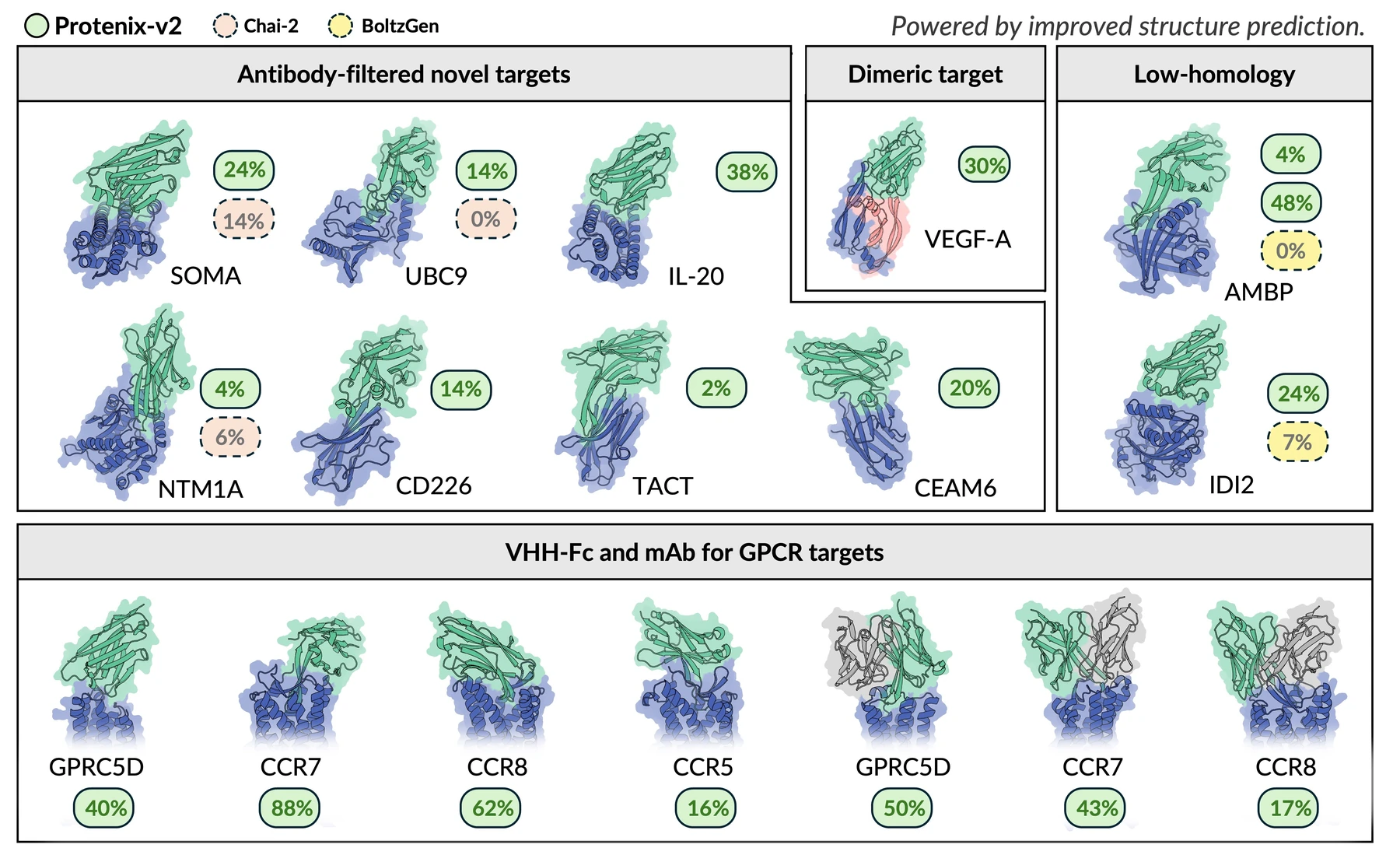
Figure 1. Previously reported antibody design results from Protenix-v2, including soluble-target campaigns and VHH-Fc and mAb designs against GPCR targets. Percentages and baseline comparisons are reproduced from the original report and retain its experimental settings and definitions. These are Protenix-v2 results, presented as prior research supporting AnewDesign.
A Lab-in-the-Loop Workflow
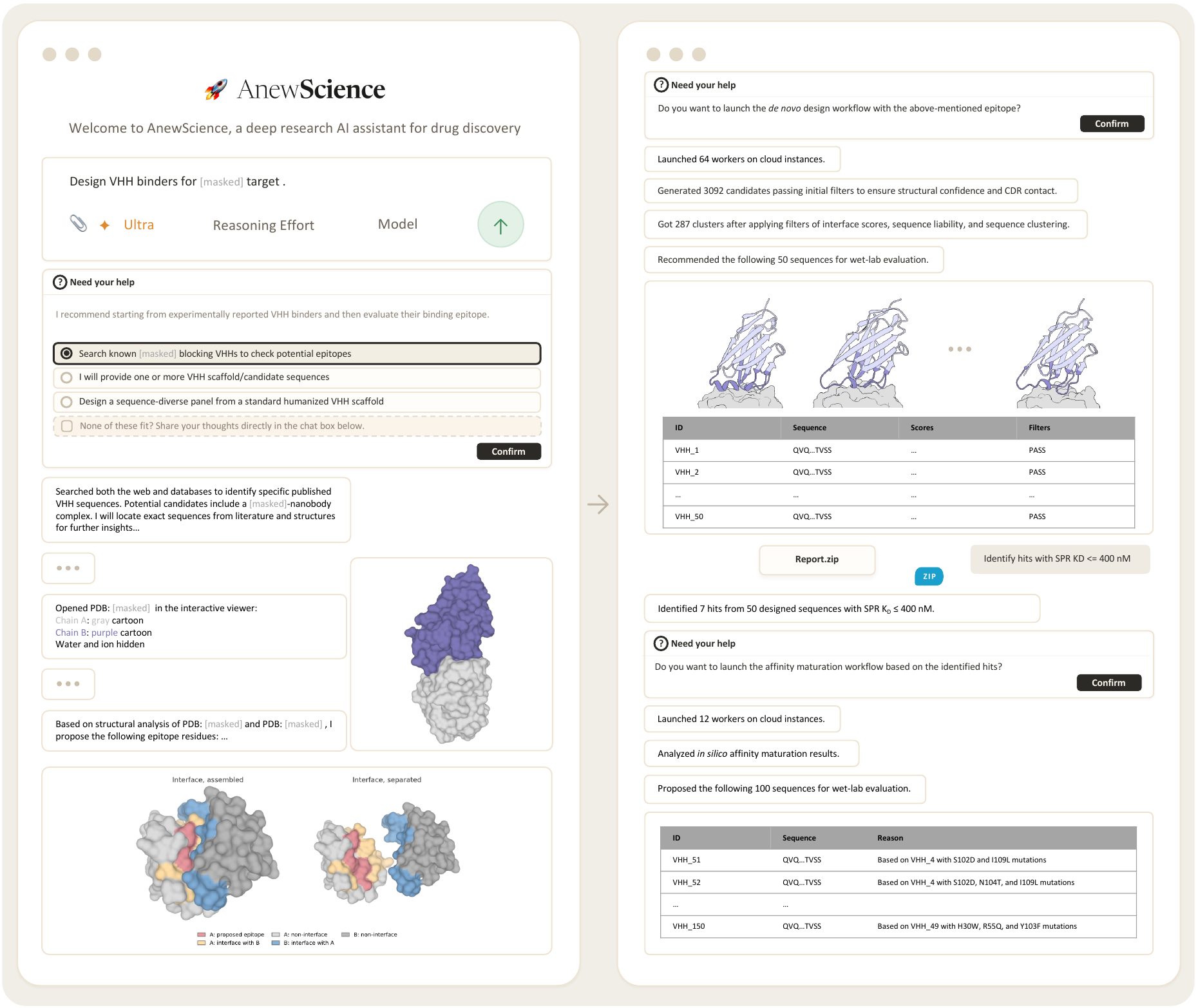
Figure 2. The AnewDesign Lab-in-the-Loop Workflow in AnewScience. Natural-language interaction connects candidate design, experimental evaluation, and affinity optimization.
From Biological Context to Candidate Design
The workflow begins with a scientist's design objective. The agent reviews relevant literature and structural information, identifies suitable reference structures, and proposes candidate epitopes informed by the intended biological mechanism.
With a target and epitope defined, the agent launches and manages computational design runs. Diffusion-based generation is combined with structure-prediction-based evaluation to produce and assess candidate binders.
Selecting Candidates for Experimental Testing
Candidate selection considers structural consistency, interface plausibility, sequence liabilities, and diversity. The workflow identifies CDR motifs associated with high-risk liabilities, including deamidation, fragmentation, isomerization, and N-linked glycosylation, and removes the corresponding sequences. The agent also clusters candidates to preserve structural and sequence diversity among designs advanced to wet-lab evaluation.
Learning from Experimental Feedback
Measured binding affinities inform subsequent optimization, alongside sequence-based assessments of potential developability liabilities. Partial diffusion-based algorithms and agent-assisted candidate selection guide in silico affinity maturation, preserving validated regions while exploring selected CDR and nearby framework residues. Experimental developability and functional characterization are subsequent evaluation steps for the optimized clones.
Nanobody Design and Optimization Against an Internal Target
Initial Design and Experimental Evaluation
To demonstrate the AnewDesign workflow, we conducted a proof-of-concept nanobody design campaign against an internal protein target. The agent begins with experimentally reported VHHs to assess their binding epitopes, then retrieves relevant literature and patents and queries structural and sequence databases to characterize the target. A published crystal structure provides a reference for identifying candidate epitope residues. A separate structure of the target protein bound to its interaction partner helps assess whether the proposed epitope is relevant to the intended blocking mechanism. Once the target and epitope are established, the agent launches and manages computational design runs combining diffusion-based generation with structure-prediction-based evaluation.
Of 50 nanobody candidates tested in the initial round, seven showed target binding with SPR-measured affinities (K_D) of 46–390 nM, corresponding to a 14% hit rate. Experimental feedback then guided further affinity optimization.
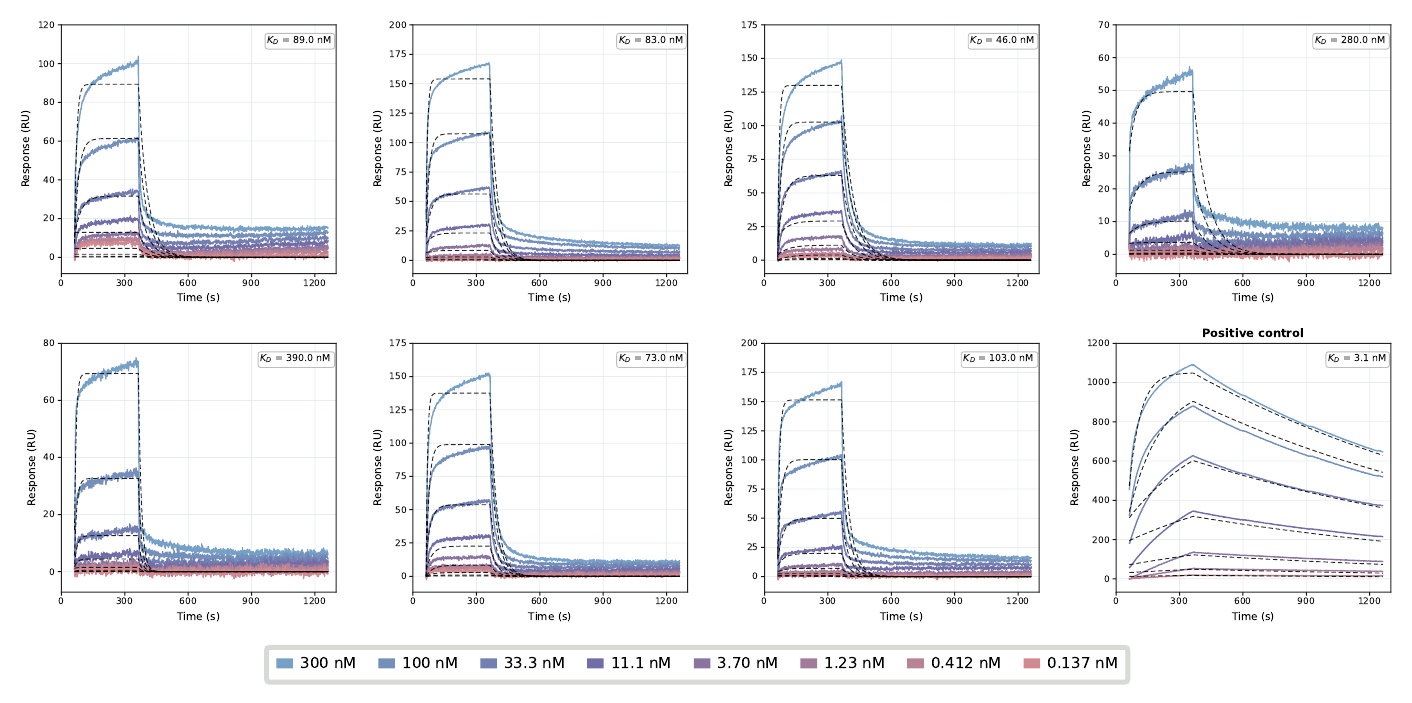
Figure 3. Seven nanobody candidates from the initial design round, with SPR-measured affinities of 46–390 nM.
Experimental-Feedback-Guided Affinity Optimization
Optimization guided by experimental feedback yielded 16 nanobody candidates with SPR-measured affinities of 1.8–8.1 nM. Across the initial design and optimization stages, 16 of 150 tested clones achieved single-digit nanomolar binding affinities, corresponding to an overall success rate of 10.7%.
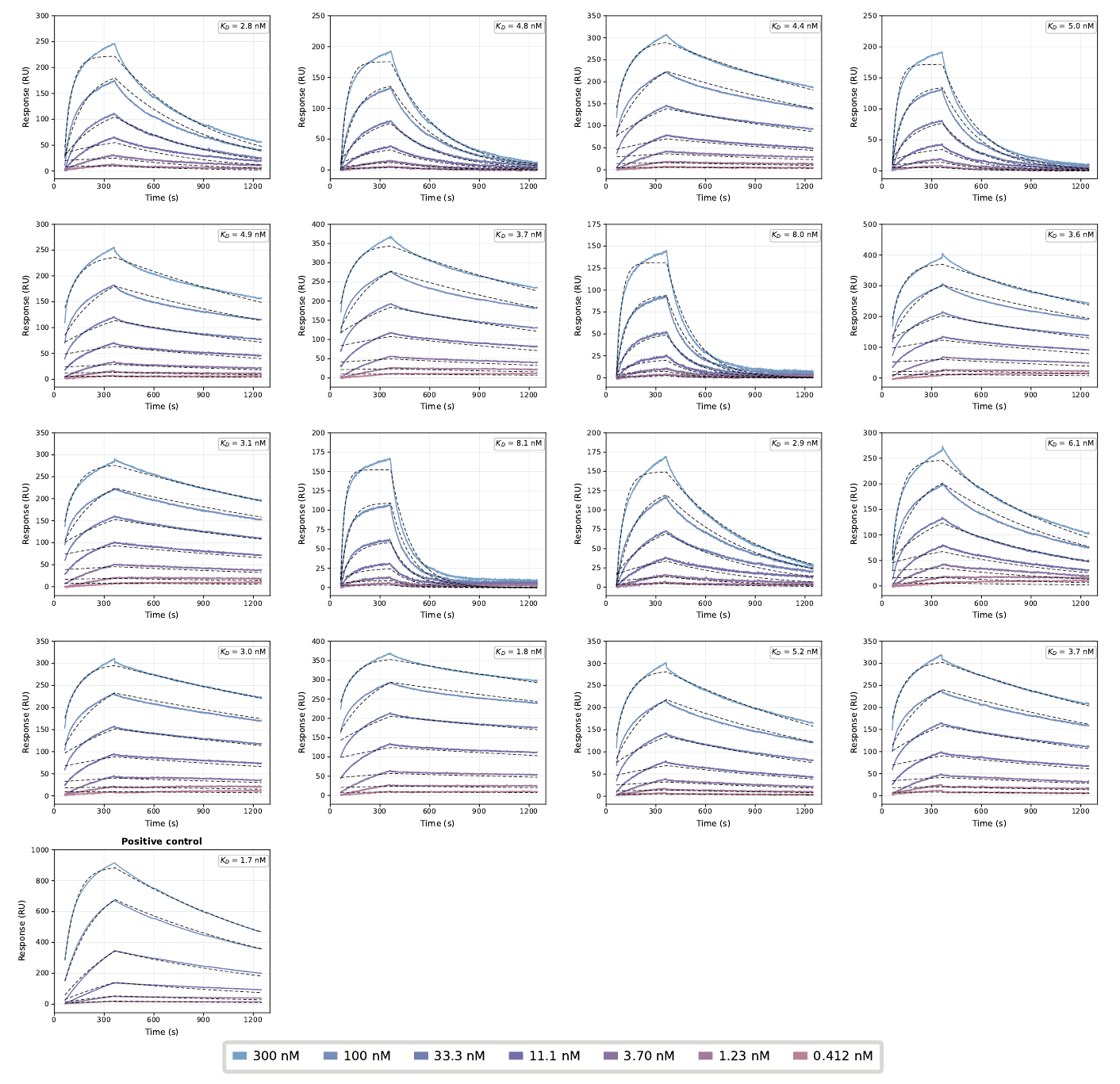
Figure 4. Following optimization guided by experimental feedback, 16 nanobody candidates achieved SPR-measured affinities of 1.8–8.1 nM.
These results demonstrate the application of AnewDesign to nanobody generation and affinity optimization in an internal-target proof of concept. The reported measurements establish binding affinity. The optimized clones are ready for subsequent developability and functional evaluation.
Outlook
AnewDesign connects the team's research in protein and antibody design with an experimental-feedback-driven workflow. The internal-target study provides an initial proof of concept for this integration within AnewDDE. Further studies across additional disease-relevant targets, together with functional and developability assays, will help establish the workflow's broader applicability.